
merchant navy
Merchant Navy Job in India 2026: How to Get Your First Job — The Complete Guide
- Apr 06, 2026
Looking for a Merchant Navy job in India? Eligibility, top courses, DGS-approved colleges, fresher salary & step-by-step application guide - updated 2026.
Introduction – Why Merchant Navy is a High-Paying, Underrated Career in India
India is one of the world's top seafarer-supplying nations - contributing over 2,40,000 professionals to the global merchant fleet. Yet, finding your first Merchant Navy job in India remains one of the most confusing processes for fresh candidates. Which course? Which college? What documents? How long does it take?
This guide answers all of it - clearly, in the right order, with real numbers.
By the time you finish reading, you'll know exactly which course fits your background, what the medical test involves, how much a fresher earns, which companies hire in India, and the step-by-step process to land your first contract - even with zero sea experience.
What is the Merchant Navy and What Does a Seafarer Actually Do?
Before anything else, let's clear up the biggest confusion most Indian students have.
Merchant Navy ≠ Indian Navy.
The Indian Navy is a branch of the armed forces. You wear a uniform, you defend the country, and it's a government job with a fixed career path.
The Merchant Navy is completely different. It's a commercial fleet - ships that carry cargo, oil, chemicals, containers, and passengers across oceans. You work for private shipping companies (sometimes government-owned ones like SCI), earn in US dollars, and travel the world as part of your job.
What departments exist on a merchant ship?
Deck Department – Navigation officers who run the bridge, plan routes, and oversee cargo operations. The career path: Deck Cadet → Third Officer → Second Officer → Chief Officer → Captain (Master).
Engine Department – Marine engineers who keep the ship's machinery running. Path: Engine Cadet → Fourth Engineer → Third Engineer → Second Engineer → Chief Engineer.
Electro-Technical Officer (ETO) – A newer, fast-growing role focused on electrical systems, automation, and electronics onboard. High demand, less competition.
Catering & Hospitality – Mostly relevant for passenger ships and cruise liners. Cooks, stewards, and hotel staff fall here.
What types of ships are out there?
- Tankers – Carry crude oil, chemicals, or liquefied gas
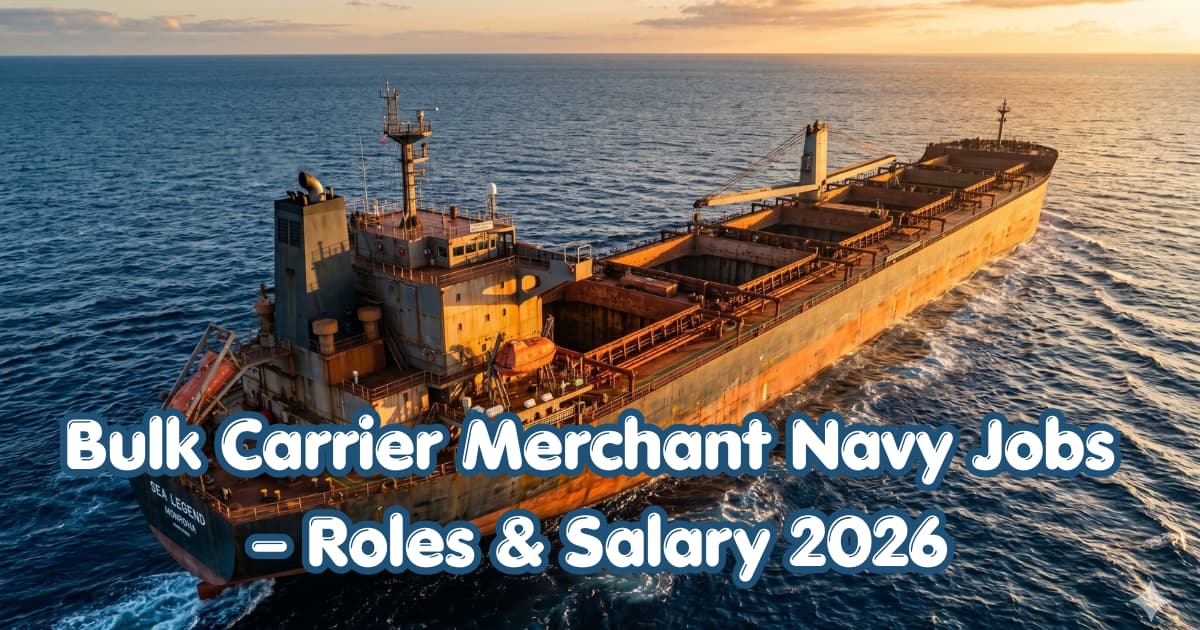
- Bulk Carriers – Carry iron ore, coal, grain
- Container Ships – The backbone of global trade
- Passenger/Cruise Ships – The ones you see in Instagram travel reels
Each ship type has its own work culture, risks, and salary scales. More on that later.
Eligibility Requirements to Join Merchant Navy in India (Deck, Engine & ETO)
This is where most students get confused — so let's break it down clearly by department.
After 12th (Science – PCM)
If you've done Physics, Chemistry, and Maths in Class 12, you're eligible for:
- DNS (Diploma in Nautical Science) — Deck department entry
- B. Sc Nautical Science — Deck department, degree-level
- Graduate Marine Engineering (GME) — Engine department (requires a BE/B. Tech in Mechanical/Marine Engineering first)
- B.E. Marine Engineering — Engine department, 4-year degree
ETO Route (PCM or PCB)
The ETO course requires a diploma or degree in Electrical/Electronic Engineering. Some institutes also accept PCB with electronics background.
After 10th
Even if you haven't done 12th yet, there are options:
- GP Rating (General Purpose Rating) — Deck or Engine
- Saloon Rating — Catering department
These are crew-level roles (not officer track), but they're a legitimate entry point into the industry.
Age Limits
As per DGS (Directorate General of Shipping) norms:
- DNS / B. Sc Nautical Science: 17–25 years at time of joining
- GME / B.E. Marine Engineering: depends on the institute, typically 17–28 years
- GP Rating: 17.5 years minimum
Medical Fitness
This is non-negotiable. You need to pass an ENG1 or INDOS medical test conducted by a DGS-approved doctor. Key requirements:
- Eyesight: corrected vision acceptable for most courses (more on this in the medical section)
- Colour vision: for Deck officers, normal colour vision is mandatory. This is a hard disqualifier.
- BMI within acceptable range
- No major cardiac, neurological, or hearing issues
Other Requirements
- Must be an Indian citizen
- You'll need an INDOS number (Indian National Database of Seafarers) — this is your unique seafarer ID, registered with DGS
- Course must be from a DGS-approved institute — this is critical and often ignored in other guides. Joining an unapproved institute means your certificate won't be valid for employment.
Which Merchant Navy Course Should You Choose? (DNS, B. Sc Nautical Science, GME, ETO – Compared)
Here's the comparison table nobody else has put together cleanly:
| Course | Duration | Eligibility | Avg. Cost (INR) | Career Track | DGS Approved? |
| DNS (Diploma in Nautical Science) | 1 year (pre-sea) | 12th PCM, 60%+ | ₹3–6 Lakhs | Deck Officer → Captain | Yes (mandatory) |
| B.Sc Nautical Science | 3 years | 12th PCM, 60%+ | ₹8–15 Lakhs | Deck Officer → Captain | Yes |
| B.E. Marine Engineering | 4 years | 12th PCM | ₹6–12 Lakhs | Marine Engineer → Chief Engineer | Yes |
| GME (Graduate Marine Engineering) | 1 year (pre-sea) | BE/B.Tech Mech/Marine | ₹2–5 Lakhs | Marine Engineer → Chief Engineer | Yes |
| ETO Course | 6–12 months | Diploma/Degree in EE | ₹2–4 Lakhs | ETO → Senior ETO | Yes |
| GP Rating (Deck/Engine) | 6 months | 10th pass | ₹50K–1.5 Lakhs | Rating → Petty Officer | Yes |
Which one is right for you?
- Choose DNS if you want the fastest route to becoming a Deck Officer and have a 12th PCM background. It's the most popular entry-level officer course in India.
- Choose B.Sc Nautical Science if you want a degree alongside your maritime training — useful if you ever want to switch careers or pursue higher education later.
- Choose B.E. Marine Engineering if you're interested in engines and machinery and want a full engineering degree.
- Choose GME if you already have a B.Tech/BE in Mechanical and want to enter the engine department quickly without a 4-year course.
- Choose ETO if your background is in electrical or electronics engineering. This department is growing fast with increasing ship automation, and competition is still lower than Deck or Engine.
- Choose GP Rating if you want to start early, earn while you learn, and work your way up. It's not glamorous at the start, but it's a proven path.
Top Merchant Navy Colleges in India – Comparison Table (2026)
| Institute | Location | Courses | DGS Approved | Est. Placement Rate | Approx. Fees |
| T.S. Chanakya | Navi Mumbai | DNS, B.Sc Nautical Sc. | Yes | 85–90% | ₹5–8 Lakhs |
| MERI (Maritime Energy Research Institute) | Kolkata | DNS, GME, ETO, GP Rating | Yes | 80–85% | ₹3–6 Lakhs |
| IMU Chennai (Indian Maritime University) | Chennai | All major courses | Yes | 75–85% | ₹6–14 Lakhs |
| Coimbatore Marine College | Coimbatore, Tamil Nadu | DNS, B.Sc Nautical Sc., GP Rating | Yes | 70–80% | ₹4–7 Lakhs |
| SCI (Shipping Corporation of India) Training | Mumbai | DNS, GME | Yes | 90%+ (direct placement) | ₹4–6 Lakhs |
| HIMT (Hindu Institute of Maritime Training) | Chennai | DNS, B.Sc Nautical Sc., ETO | Yes | 75–80% | ₹5–9 Lakhs |
| Tolani Maritime Institute | Pune | B.Sc Nautical Sc., Marine Engg | Yes | 80–85% | ₹10–15 Lakhs |
Who should go where?
- T.S. Chanakya is widely considered the gold standard for DNS in India. Strong alumni network, excellent placement ties with international shipping companies. If you get a seat here, take it.
- MERI Kolkata is a solid all-rounder - good for students from eastern India who want a balance of quality and cost.
- IMU Chennai is a government university, which means slightly lower fees and a wide range of courses. Great for Tamil Nadu students seeking UGC-recognized degrees.
- Coimbatore Marine College is a growing institute with strong local placement support - a good option for students from Tamil Nadu who want to stay close to home during training.
- SCI Training - if you get sponsored by SCI, that's arguably the best deal in the country. Direct placement, brand name, good salary scale.
- HIMT Chennai has strong industry connections in the South India market, especially for Deck and ETO roles.
Merchant Navy Medical Requirements: What the ENG1/INDOS Fitness Test Involves
A lot of students reach the final stage and get rejected at medical. Don't let that be you.
Eyes
For Deck Officers (DNS/B. Sc), colour vision is mandatory. If you're colour blind — even mildly — you cannot become a navigating officer. This is a DGS rule, not just a company policy.
For Engine Officers and ETO, colour blindness is a disqualifier for some companies but not all. Check with your institute.
Corrected vision (glasses or contact lenses) is allowed for most roles. Many students ask: "Can I join merchant navy with glasses?" — Yes, you can, as long as your corrected vision meets the standard (typically 6/6 with correction for Deck).
Other Standards
- Hearing: Must pass a standard hearing test (no significant hearing loss)
- BMI: Should be within the normal/acceptable range — extreme obesity or underweight can be flagged
- Blood pressure: Must be within safe limits
- Dental: Basic dental fitness, no active severe infections
- Mental health: No history of psychiatric illness that could be a risk at sea
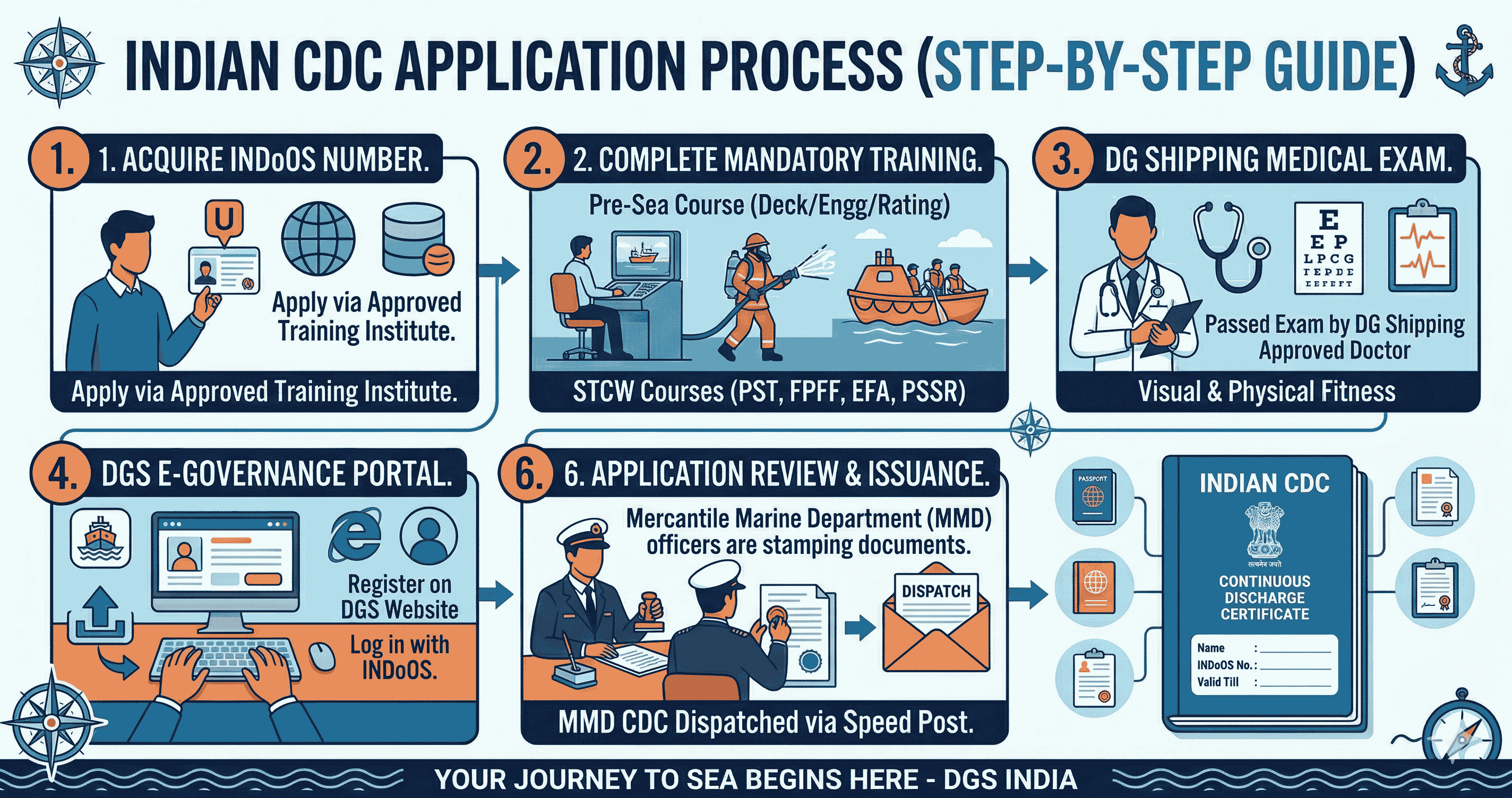
The medical is done by a DGS-empanelled doctor. You can find the updated list of approved medical examiners on the DGS India website (dgshipping.gov.in). Don't go to just any doctor - the certificate has to be from a panel doctor, or it won't be accepted.
Merchant Navy Salary in India: What Freshers Actually Earn (Department-wise)
This is the section everyone scrolls to first — so let's be straight about it.
Entry-Level Salary (Approximate)
| Role | Monthly Salary (USD) | Monthly in INR (approx.) |
| Deck Cadet (DNS fresher) | $400–800 | ₹33,000–67,000 |
| Engine Cadet (GME/BE fresher) | $400–800 | ₹33,000–67,000 |
| ETO (Entry level) | $800–1,200 | ₹67,000–1,00,000 |
| GP Rating (Deck/Engine) | $300–600 | ₹25,000–50,000 |
These are your first contract numbers. Within 2–3 years, after getting your Officer of the Watch (OOW) or Junior Engineer certificate, salaries jump significantly — senior officers and chief engineers can earn $5,000 - $10,000+ per month.
Now the big question everyone asks: Is merchant navy salary tax-free in India?
Yes - for most seafarers. Under the Indian Income Tax Act, income earned while working on a foreign-going ship is not taxable, provided you qualify as a Non-Resident Indian (NRI) for that financial year (meaning you spent 182+ days outside India). Most seafarers on international voyages easily qualify. This is one of the most significant financial advantages of a seafaring career.
For comparison, a fresh mechanical engineer in India earns ₹20,000–35,000/month on average - and pays tax on top of that. A Deck or Engine Cadet earns more from day one, and pays no tax on it.
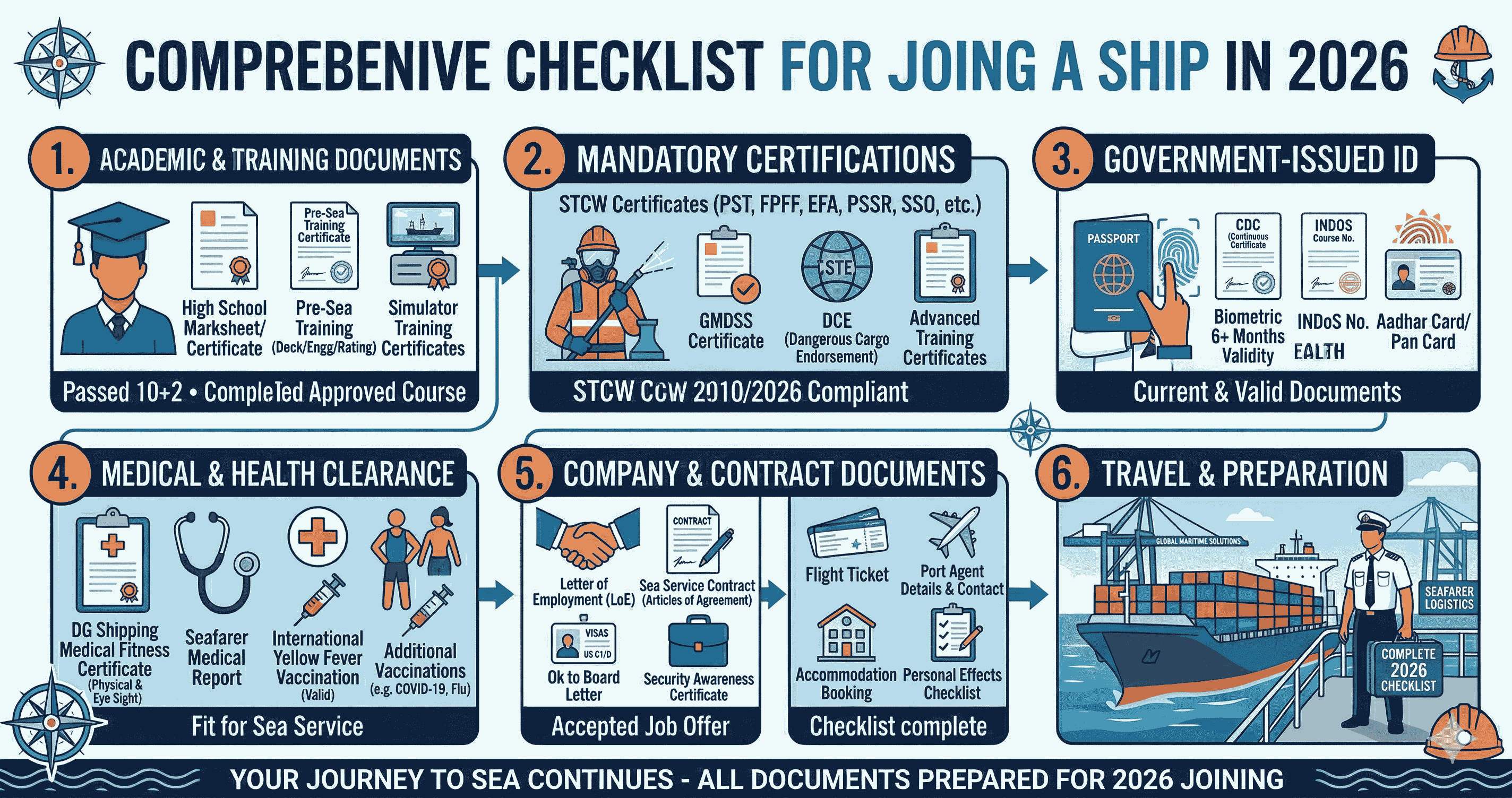
STCW certificates - Basic Safety Training and other STCW (Standards of Training, Certification and Watchkeeping) modules - are required before you join a ship and also unlock better salary grades as you progress.
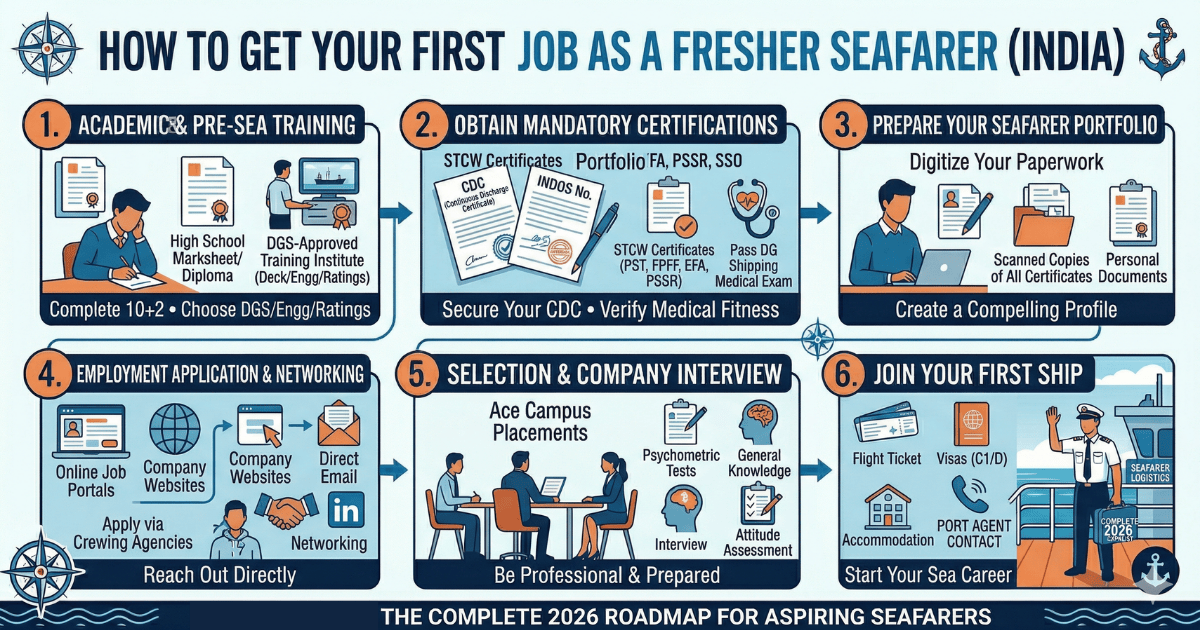
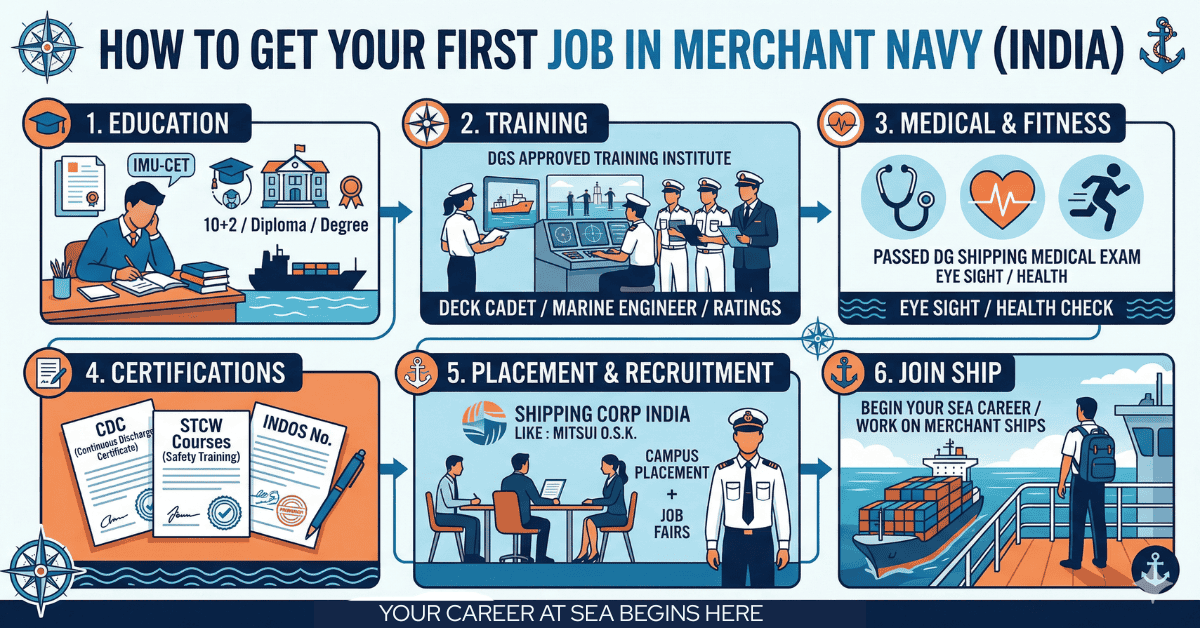
How to Get Your First Job in Merchant Navy After Course: Step-by-Step Process
This is the part most guides skip over or oversimplify. Here's the actual process:
Step 1: Complete a DGS-Approved Course and Get Your INDOS Number
Your course certificate from a DGS-approved institute is the foundation of everything. Along with it, register for your INDOS number on the DGS seafarer portal. This is your permanent seafarer ID in India.
Step 2: Complete Pre-Sea Training + STCW Basic Safety Training (BST)
BST is a mandatory 4-module training course that covers Personal Survival Techniques, Fire Prevention and Firefighting, Elementary First Aid, and Personal Safety. No company will hire you without this. It's usually done as part of your institute course, but confirm this before you enrol.
Step 3: Get Your CDC (Continuous Discharge Certificate)
This is your seafarer's service record book. Think of it as a passport for your sea career — every ship you join, every contract you complete, gets stamped here. Apply through the DGS office. Without a CDC, you legally cannot join a vessel.
Step 4: Prepare Your Seafarer CV and SID
A seafarer's CV is different from a regular CV. It should list your certificates, STCW trainings, medical fitness validity, passport details, and INDOS number. Also apply for your SID (Seafarer's Identity Document) — it gives you easier port access in many countries.
Step 5: Apply Through the Right Channels
- Shipping company websites – Most large companies like Anglo-Eastern, BSM, and Fleet Management have cadet application portals
- Crewing agents – Manning agencies like InterManager and Indian crew managers recruit on behalf of ship owners
- Institute placement cells – Many DGS-approved institutes have direct tie-ups with shipping companies
- LinkedIn – Yes, it works for maritime jobs too, especially for ETO and officer roles
Step 6: Medical Fitness Certificate + Flag State Documentation
Before joining a vessel, you'll need a valid ENG1/INDOS medical certificate and any flag state-specific documents (depends on which country's flag the ship is registered under — Panama, Marshall Islands, etc. are common). Your company's crew manager will guide you through this.
The whole process from completing your course to joining your first vessel typically takes 3–9 months. Freshers who are proactive with applications and have a clean medical record tend to get placed faster.
Top Shipping Companies That Hire Freshers in India (With Application Tips)
| Company | Fleet Type | Cadet Intake | How to Apply |
| SCI (Shipping Corporation of India) | Mixed (tankers, bulk, containers) | Yes, annual cadet batches | dgshipping.gov.in or SCI HR portal |
| Anglo-Eastern Ship Management | Tankers, bulk carriers | Yes, strong cadet programme | angloeastern.com/careers |
| Bernhard Schulte Shipmanagement (BSM) | Tankers, containers, LNG | Yes | bs-shipmanagement.com |
| Fleet Management | Bulk carriers, tankers | Yes | fleetship.com |
| Tolani Shipping | Bulk carriers | Yes, especially DNS cadets | tolanishipping.com |
| Essar Shipping | Tankers | Occasional | Via campus placement |
| V.Ships | Mixed fleet | Yes | vships.com |
What makes a merchant navy fresher CV stand out?
- All certificates listed with validity dates (STCW, medical, CDC number if available)
- Clean, maritime-specific format (no fancy graphics — recruiters use ATS systems)
- Cover letter that mentions your specific interest in the company's fleet type
- Any relevant internship or shipboard training mentioned prominently
- Accurate contact details and passport validity — expired passport is an immediate rejection
One small tip most people miss: apply to companies whose fleet matches your training focus. A DNS graduate should prioritise bulk carriers and tankers for first contracts — they're more straightforward operationally than LNG or chemical tankers, which have steeper learning curves for freshers.
FAQs: How to Get First Job in Merchant Navy India
Can I join merchant navy after a commerce or arts background?
For officer-level courses (DNS, Marine Engineering), no — PCM is mandatory. However, the Catering/Hospitality department on cruise ships doesn't require a science background. GP Rating (Deck) requires only a 10th pass. If you've done 12th commerce or arts, your options are limited but not zero.
What is the minimum age to join merchant navy in India?
For most pre-sea officer courses, the minimum age is 17 years at the time of joining. For GP Rating, it's 17.5 years. There's no strict upper limit for changing careers into merchant navy, but most companies prefer cadets under 25–28 for first contracts.
Is merchant navy good for girls in India?
Absolutely. Women are working across all departments — Deck, Engine, ETO, and Catering. The industry is more open than it was 10 years ago. Companies like Anglo-Eastern and BSM actively recruit female cadets. There are specific accommodation standards required on ships that hire female seafarers, which most modern vessels already meet.
How long does it take to get first job after merchant navy course?
On average, 3–9 months after completing your pre-sea course and STCW training. Students from institutes with strong placement cells often sign contracts within 1–3 months of passing out.
Can I join merchant navy with spectacles?
Yes, for most roles. Corrected vision with glasses or contacts is acceptable. The requirement is that your corrected vision meets the standard — not that your eyes are perfect without correction. Exception: some flag states or companies may have stricter rules, so verify before applying.
What is the difference between merchant navy and Indian Navy?
Indian Navy = armed forces, government job, military role, INR salary. Merchant Navy = commercial shipping, private or public companies, USD salary, no military obligation. Completely different in terms of work, lifestyle, and pay structure.
Is merchant navy salary tax-free in India?
Yes, in most cases. If you spend 182+ days outside India in a financial year (which most seafarers on foreign-going ships do), your income qualifies for NRI status under the Income Tax Act, making it non-taxable. Always consult a CA familiar with seafarer taxation to be sure.
Which is the best course for merchant navy after 12th PCM?
DNS (Diploma in Nautical Science) if you want the fastest route to becoming a Deck Officer. B.E. Marine Engineering if you prefer engines and want a full engineering degree. The "best" course depends on which department interests you and how much time and money you want to invest upfront.
How many months is a typical first contract for a cadet?
Most first contracts for Deck or Engine Cadets are 6–9 months. After returning, you apply for your Officer of the Watch (OOW) or Junior Engineer certificate, then return for officer-level contracts.
Do I need to know swimming to join merchant navy?
You don't need to be an expert swimmer, but basic swimming ability is helpful and may be tested informally. The STCW Personal Survival Techniques module will teach you survival skills in water. Not knowing how to swim won't automatically disqualify you from most courses, but learn the basics — it's a safety matter.
What is STCW certification and is it mandatory?
STCW stands for Standards of Training, Certification and Watchkeeping — an international convention that sets the minimum training standards for seafarers. The Basic Safety Training (BST) under STCW is mandatory for everyone before joining a ship. As you progress in your career, additional STCW certificates are required for specific roles and vessel types.
Can merchant navy cadets get a loan for course fees?
Yes. Most nationalised banks in India (SBI, Canara Bank, Indian Bank) offer education loans for DGS-approved maritime courses under the Vidya Lakshmi Portal. Some institutes also have tie-ups with lenders for easier processing. The strong placement rates in this industry make maritime courses a relatively low-risk loan for banks.
Conclusion: Your Merchant Navy Career Starts with One Right Decision
Here's the short version of everything we covered:
Get your eligibility right → Pick the correct DGS-approved course → Clear your medical → Get your CDC and STCW certifications → Apply strategically to companies and crewing agents → Join your first vessel.
That's the path. It's not complicated once someone lays it out clearly — which is exactly what most students were missing.
And the reward at the end of that path? A tax-free salary in USD, the experience of working across continents, faster career growth than almost any land-based engineering role, and a profession that very few people fully understand — which means less competition for those who do get in.
Still unsure which course fits your background, budget, or career goals? That's exactly what a counselling call is for. We've helped hundreds of students across India figure out their best route into the merchant navy — and we'll be straight with you about what makes sense for your specific situation.
Book a Free Counselling Call and take the first step today.